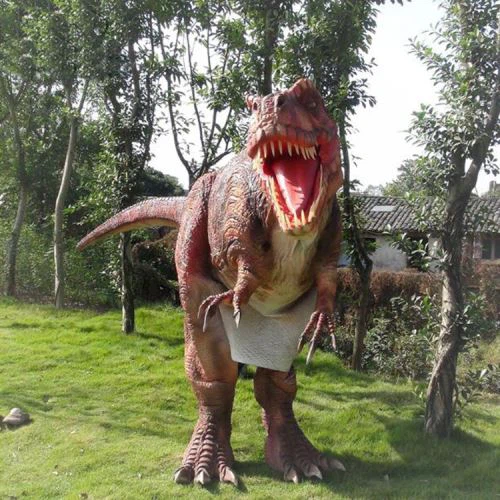
As a supplier of Raptor Dinosaur Costumes, I've always been passionate about bringing these prehistoric creatures to life in the most realistic and engaging way possible. Adding more details to a Raptor Dinosaur Costume can significantly enhance its authenticity, appeal, and overall quality. In this blog post, I'll share some of the techniques and ideas I've gathered over the years to help you create a more detailed and impressive Raptor Dinosaur Costume.
Understanding the Raptor Anatomy
Before you start adding details to your Raptor Dinosaur Costume, it's crucial to have a solid understanding of the raptor's anatomy. Raptors were small to medium-sized theropod dinosaurs known for their sharp claws, long tails, and agile bodies. They had a distinctive body shape with a large head, powerful hind legs, and relatively small forelimbs.
To accurately replicate the raptor's anatomy in your costume, you can refer to scientific illustrations, fossil reconstructions, and documentaries. Pay close attention to the proportions, muscle structure, and bone placement. This knowledge will serve as a foundation for adding realistic details to your costume.
Adding Texture to the Skin
One of the most effective ways to make your Raptor Dinosaur Costume more realistic is to add texture to the skin. In nature, raptor skin was likely covered in scales or feathers, depending on the species. You can use various materials to create these textures, such as foam, latex, or fabric.
For scale textures, you can use a heat gun to shape foam sheets into small, overlapping scales. Attach these scales to the costume using glue or stitching. You can also use a texture roller or a stencil to create a scale pattern on the fabric. For feather textures, you can use faux feathers or create your own feathers using fabric or paper. Attach the feathers to the costume in a way that mimics the natural feather arrangement on a raptor.
Incorporating Color and Patterns
Color and patterns play a crucial role in making your Raptor Dinosaur Costume more visually appealing. In nature, raptors had a variety of colors and patterns, which helped them blend in with their environment or attract mates. You can use paint, fabric dyes, or colored fabric to add color and patterns to your costume.
When choosing colors and patterns, consider the species of raptor you're trying to replicate. For example, some raptors had stripes or spots, while others had solid colors. You can also use reference images to get inspiration for color combinations and patterns.


Adding Details to the Head
The head is one of the most important parts of a Raptor Dinosaur Costume, as it is the first thing people will notice. To make the head more realistic, you can add details such as teeth, eyes, and a beak.
For teeth, you can use foam or latex to create individual teeth and attach them to the inside of the mouth. You can also use a mold to create a set of teeth that fit into the mouth. For eyes, you can use acrylic or glass eyes and attach them to the head using glue or stitching. You can also add a layer of fabric or paint to create the appearance of eyelids. For the beak, you can use foam or latex to create a beak shape and attach it to the front of the head.
Adding Movement and Animation
To make your Raptor Dinosaur Costume more engaging, you can add movement and animation. You can use motors, servos, or springs to create movement in the head, tail, or limbs. You can also use sound effects and lighting to enhance the overall experience.
For example, you can install a motor in the head to make it move up and down or side to side. You can also install a servo in the tail to make it wag or curl. You can use a sound board to play raptor sounds, such as growls, roars, or screeches. You can also install LED lights in the eyes or mouth to create a glowing effect.
Using Accessories
Accessories can add an extra layer of detail and authenticity to your Raptor Dinosaur Costume. You can use accessories such as claws, spikes, or armor to make the costume more visually appealing.
For claws, you can use foam or latex to create individual claws and attach them to the hands and feet. You can also use a mold to create a set of claws that fit over the hands and feet. For spikes, you can use foam or latex to create spike shapes and attach them to the back or tail. For armor, you can use plastic or metal plates to create a protective layer over the body.
Testing and Refining
Once you've added all the details to your Raptor Dinosaur Costume, it's important to test it and refine it. Wear the costume and walk around to see how it feels and moves. Make sure all the details are secure and that the costume is comfortable to wear.
If you notice any issues or areas that need improvement, make the necessary adjustments. You can also get feedback from others and use their suggestions to make the costume even better.
Conclusion
Adding more details to a Raptor Dinosaur Costume can significantly enhance its authenticity, appeal, and overall quality. By understanding the raptor's anatomy, adding texture to the skin, incorporating color and patterns, adding details to the head, adding movement and animation, using accessories, and testing and refining the costume, you can create a more realistic and engaging Raptor Dinosaur Costume.
If you're interested in purchasing a high-quality Raptor Dinosaur Costume or other dinosaur costumes, such as the Animatronic Dragon Costume, Dinosaur Costume for Outdoor Playground, or T Rex Dinosaur Costume, please feel free to contact us for more information and to discuss your specific needs. We're here to help you bring your prehistoric dreams to life!
References
- "The Complete Dinosaur" by James O. Farlow and M. K. Brett-Surman
- "Dinosaurs: The Most Complete, Up-to-Date Encyclopedia for Dinosaur Lovers of All Ages" by Thomas R. Holtz Jr.
- National Geographic Documentaries on Dinosaurs