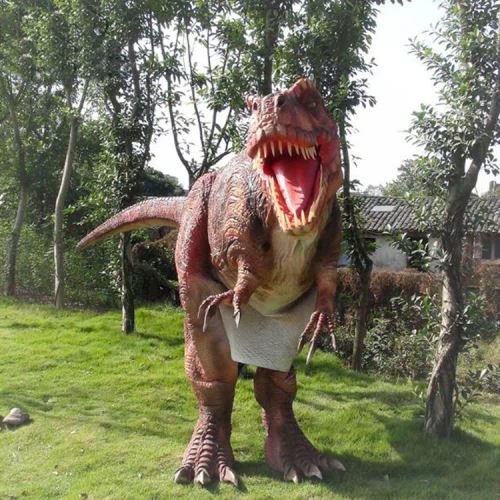
When it comes to creating an immersive and educational experience centered around the prehistoric world, dinosaur park models play a pivotal role. As a supplier of high - quality dinosaur park models, I've had the privilege of witnessing firsthand the significance of detail in these models. In this blog, I'll delve into just how detailed our dinosaur park models are and why these details matter.
The Scientific Accuracy of Our Models
One of the cornerstones of our dinosaur park models is scientific accuracy. We understand that dinosaurs roamed the Earth millions of years ago, and to bring them back to life authentically, we rely on the latest paleontological research. Our team of experts closely follows scientific findings, including skeletal structures, muscle attachments, and even potential skin textures.
For instance, the skeletal details of our models are based on well - studied fossils. We painstakingly recreate every bone, from the large femurs to the tiny phalanges. This level of detail not only provides an accurate representation of the dinosaur's physical structure but also allows for a more educational experience. Visitors to an Animatronic Dinosaur Park can learn about the different parts of a dinosaur's body and how they functioned.

Muscle details are another area where we excel. By studying the muscle attachments on the bones and comparing them to modern - day reptiles and birds, we can create models that show the dynamic movement capabilities of dinosaurs. Whether it's the powerful leg muscles that allowed a T - rex to chase its prey or the wing muscles of a pterosaur enabling flight, these details add a layer of realism to our models.
Skin texture is also a crucial aspect of scientific accuracy. New research has suggested that some dinosaurs may have had feathers, while others had scaly skin. Our models reflect these findings, with feathers carefully crafted to look and feel realistic, and scales molded to match the patterns and sizes found in the fossil record.
Color and Pigmentation
Determining the color of dinosaurs is a challenging task since color doesn't typically fossilize. However, our team uses a combination of scientific speculation and artistic interpretation to bring color to our models. We consider factors such as the environment in which the dinosaur lived, its likely behavior, and the coloration of modern - day animals with similar lifestyles.
For example, dinosaurs that lived in dense forests may have had camouflage colors to blend in with their surroundings. We use a variety of painting techniques to create realistic color gradients and patterns. The colors are not only aesthetically pleasing but also serve an educational purpose. They can help visitors understand how dinosaurs may have used color for communication, mating displays, or protection.
Animatronic Details
Our animatronic dinosaur models take detail to a whole new level. These models are equipped with state - of - the - art technology that allows for lifelike movement. We carefully design the animatronic mechanisms to mimic the natural movements of dinosaurs.
The joints of our animatronic dinosaurs are designed to move in a way that is consistent with their skeletal structure. For example, a T - rex's legs can move in a realistic walking or running motion, with the knee and hip joints bending at the appropriate angles. The head and neck movements are also incredibly detailed. A Brachiosaurus can raise and lower its long neck, simulating how it may have reached for leaves on tall trees.
Sound effects are another important part of the animatronic experience. We use recorded and synthesized sounds based on what scientists believe dinosaurs may have sounded like. The roars of a carnivorous dinosaur can send shivers down the spines of visitors, while the gentle calls of a herbivore add to the overall atmosphere of the park.
Environmental and Habitat Details
In addition to the dinosaurs themselves, our models often come with detailed environmental and habitat elements. When creating a Gaint Dinosaur Head display or an entire animatronic park, we consider the ecosystem in which the dinosaurs lived.
We recreate the prehistoric plants that would have been part of the dinosaur's diet. These plants are made with realistic materials and colors to match the types of flora that existed during the Mesozoic era. The ground cover, such as mosses and ferns, is also carefully crafted to give the impression of an ancient landscape.
Water features are another important aspect of our habitat details. Streams, ponds, and waterfalls are added to the models to represent the water sources that dinosaurs would have relied on. The water is made to look and flow realistically, adding to the overall immersive experience.
The Role of Detail in Education and Entertainment
The high level of detail in our dinosaur park models serves both educational and entertainment purposes. From an educational perspective, the detailed models provide a hands - on learning experience for visitors of all ages. Students can study the anatomy of dinosaurs, learn about their behavior, and understand the prehistoric environment in a more engaging way than through textbooks alone.
For entertainment, the realistic models create a sense of wonder and excitement. Visitors feel like they have stepped back in time to the age of dinosaurs. The animatronic movements and sounds add an element of thrill, making the experience unforgettable.
Theme Park Insect Models
In addition to our dinosaur models, we also offer Theme Park Insect Model. These models are equally detailed and play an important role in creating a complete prehistoric ecosystem. Insects were an important part of the dinosaur - era food chain, and our models accurately represent their size, shape, and color.

The details in these insect models are based on fossil evidence and scientific research. We use high - quality materials to create realistic textures, from the delicate wings of a dragonfly to the hard exoskeleton of a beetle. These models can be incorporated into our dinosaur park displays to add an extra layer of realism and educational value.
Why Choose Our Dinosaur Park Models?
Our commitment to detail sets us apart from other suppliers. We believe that every aspect of a dinosaur park model should be as accurate and realistic as possible. Whether it's the smallest bone in a dinosaur's foot or the pattern on an insect's wing, we pay attention to the details.
Our models are also built to last. We use high - quality materials that can withstand the elements, ensuring that your investment in our models will provide long - term value. In addition, we offer customization options, allowing you to create a unique dinosaur park experience that meets your specific needs.
If you're interested in creating an immersive dinosaur park, whether it's for a theme park, a museum, or a private event, I encourage you to get in touch with us. Our team of experts can work with you to design and build the perfect dinosaur park models that will captivate your audience and provide an unforgettable experience. We're here to help you bring the prehistoric world to life with the highest level of detail and quality.

References
- Benton, M. J. (2015). Vertebrate Paleontology. Wiley - Blackwell.
- Brusatte, S. L. (2018). The Rise and Fall of the Dinosaurs: A New History of a Lost World. William Morrow.
- Prum, R. O., & Brush, A. H. (2002). The evolutionary origin and diversification of feathers. The Quarterly Review of Biology, 77(3), 261 - 295.